Oral vs Injectable Peptides: Forms and Tradeoffs
How oral and injectable peptide forms compare on bioavailability, study data and ease of use. BPC-157 oral studies, topical options and reconstitution basics.
How you take a peptide matters as much as which peptide you choose. Most research peptides are sold as lyophilized powder designed for reconstitution and injection. BPC-157 is the notable exception: its gastric origin gives it unusual acid stability, and multiple animal studies have tested oral administration directly. Topical peptides like GHK-Cu skip the needle entirely. We break down the published data on each delivery route, flag the species tested and compare the products available in each form.
Why Delivery Route Matters
Bioavailability Is Route-Dependent
A peptide's biological effect depends on how much reaches its target tissue. Subcutaneous injection delivers the full dose below the skin where it enters systemic circulation. Oral delivery exposes the peptide to stomach acid and digestive enzymes, which degrade most peptide chains before absorption. Topical application delivers the compound to the skin surface but not to deeper structures like tendons or organs. Each route has tradeoffs in convenience, storage requirements and the type of tissue it can realistically reach.
Most Peptides Cannot Survive the Gut
Standard peptide bonds are cleaved by pepsin and trypsin in the gastrointestinal tract. A typical peptide taken orally would be broken into fragments before reaching the small intestine. This is why the vast majority of research peptides, including TB-500, Ipamorelin and Epithalon, are studied exclusively through injection routes. BPC-157 is a special case because of where it was discovered.
BPC-157: The Oral Exception
Gastric Origin and Acid Stability
BPC-157 is a 15-amino-acid fragment of a protein isolated from human gastric juice. Its molecular environment of origin is the stomach. In vitro testing showed that BPC-157 remained stable in solutions at pH 1 to 2 for over 24 hours, conditions that destroy most peptides within minutes. This acid stability is what makes oral administration a viable route in animal experiments. We have not seen this property replicated for any other research peptide in our catalog.
What Animal Studies Showed for Oral BPC-157
Multiple rat studies compared oral and intraperitoneal BPC-157 for gastrointestinal endpoints. In gastric ulcer models, oral BPC-157 showed dose-dependent protective effects on the mucosal lining. A colitis model found comparable outcomes between oral and injected routes. Outside the gut, the picture is less clear. Oral BPC-157 showed some systemic effects in rat tendon and wound models, but the extent of absorption and systemic distribution has not been characterized.
| Study | Model | Species | Route | Key Finding | PMID |
|---|---|---|---|---|---|
| Sikiric et al. 1993 | Gastric ulcer | Rat | Oral (in drinking water) | Dose-dependent mucosal protection | 8298609 |
| Sikiric et al. 1997 | Alcohol-induced gastric lesion | Rat | Oral, IP | Comparable gastroprotection both routes | 9298922 |
| Sikiric et al. 2006 | NSAID-induced gut damage | Rat | Oral | Reduced mucosal injury score | 16583442 |
| Seiwerth et al. 2018 | Review of GI studies | Multiple (rat) | Various including oral | Consistent protective pattern across models | 29998800 |
Injectable Peptides: SC vs IM
Subcutaneous Injection
Subcutaneous (SC) administration is the most common route in published peptide research and among research chemical users. The injection goes into the fat layer beneath the skin, typically in the abdominal area. SC delivery provides relatively slow absorption into systemic circulation, which extends the effective window. Most BPC-157 and TB-500 animal studies used intraperitoneal injection rather than SC, but the research community has adopted SC as the practical equivalent for non-abdominal injection.
Intramuscular Injection
Intramuscular (IM) injection delivers the peptide directly into skeletal muscle tissue. Absorption is faster than SC due to greater blood flow in muscle. Some anecdotal reports suggest IM injection near the site of a muscle injury, but we are not aware of published studies comparing SC versus IM BPC-157 in controlled conditions. The choice between SC and IM is largely practical rather than evidence-based for research peptides.
Reconstitution Requirement
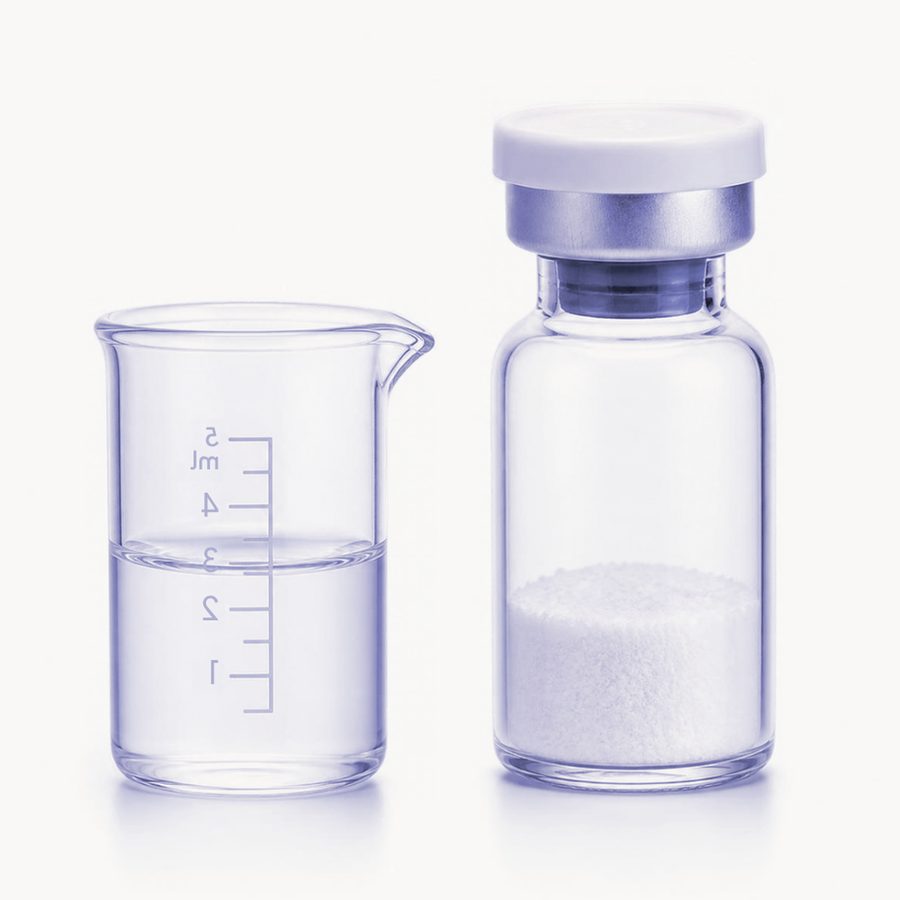
Both SC and IM routes require reconstitution of the lyophilized powder with bacteriostatic water. Real Peptides sells bacteriostatic water (10 ml) at $4.80. Once reconstituted, peptide solutions must be refrigerated and used within a limited window, typically cited as 28 to 30 days. Our reconstitution calculator provides the concentration arithmetic.
Topical Peptides: GHK-Cu
What Studies Showed
GHK-Cu is a tripeptide-copper complex studied for collagen synthesis and wound matrix remodeling. Unlike vial-based peptides, GHK-Cu is available as ready-to-use topical creams and serums. Rat wound models showed accelerated contraction and increased collagen type I deposition after topical GHK-Cu application. Small human volunteer studies measured improved skin thickness and density, though these were cosmetic rather than therapeutic endpoints.
Practical Advantages of Topical Delivery
Topical peptides do not require reconstitution, cold chain shipping or injection equipment. They are applied like any skincare product. The tradeoff is clear: delivery is limited to surface tissues. A topical GHK-Cu cream cannot reach a tendon, joint or gut lining. For skin-specific goals, this limitation is irrelevant. For anything deeper, it is disqualifying.
Nasal Peptides: Semax
Intranasal Delivery
Semax is a synthetic heptapeptide analogue of ACTH(4-10) studied in Russia for neuroprotective and cognitive effects. It is administered intranasally, bypassing the GI tract and entering circulation through the nasal mucosa. Semax is approved as a pharmaceutical product in Russia but is not FDA-approved in the United States. We include it here to illustrate that the nasal route exists as a peptide delivery method, though it is not relevant to the BPC-157 or TB-500 products in our catalog.
Route Comparison Table
| Form | Bioavailability | Ease of Use | Storage | Products in Catalog |
|---|---|---|---|---|
| Subcutaneous injection | High (systemic) | Requires reconstitution, syringe, technique | Refrigerate after reconstitution | PeptideGod BPC-157 $34.95, Real Peptides BPC-157 10 mg $43.20 |
| Intramuscular injection | High (systemic, faster onset) | Same as SC, deeper needle placement | Refrigerate after reconstitution | Same vial products as SC |
| Oral | Unknown for most peptides. BPC-157 is acid-stable. | No needle required | Dry powder shelf-stable; solution refrigerated | No oral-specific BPC-157 products in catalog |
| Topical | Local to skin surface only | Apply like skincare, no preparation | Room temperature (product-dependent) | Neurogan Face Cream $20, Neurogan Hair Serum $55, Scantifix GHK-Cu $49 |
| Intranasal | Moderate (mucosal absorption) | Spray applicator | Product-dependent | Not in current catalog |
What the Route Data Means in Practice
The majority of BPC-157 studies used intraperitoneal injection, a route that is standard in rodent research but not practical for human use. Oral administration has the second-highest study count, which is unusual for a peptide. SC injection, the most common community route, has relatively few published studies. This mismatch between research methodology and practical use is an important gap. We cannot assume that outcomes from IP injection in rats apply directly to SC injection in humans.
- Only acid-stable oral peptide
- BPC-157 (gastric origin)
- Most common research route
- Intraperitoneal (not practical for humans)
- No reconstitution needed
- Topical GHK-Cu products
- Fastest entry point (price)
- Neurogan Face Cream at $20
- Cheapest vial option
- PeptideGod BPC-157 at $34.95 (no COA, no size listed)
- Documented vial option
- Real Peptides BPC-157 10 mg at $43.20 (lot-specific COA)
What to Choose
For Topical Application Without Injections
If you want a peptide product that requires no reconstitution, no refrigeration and no injection equipment, Neurogan Health sells a GHK-Cu Copper Peptide Face Cream at $20. It contains 1200 mg of GHK-Cu at 2% concentration and carries a 4.9-star rating from 34 reviews. This is the lowest-cost entry in our topical catalog.
For Budget-Conscious Vial Purchase
If you are looking for the lowest sticker price on a BPC-157 lyophilized vial, PeptideGod lists BPC-157 at $34.95. The product page does not state the vial size in milligrams or display a COA. Price per milligram cannot be calculated without a confirmed amount.
For Documented Vial Purchase
If COA documentation and confirmed vial size matter, Real Peptides sells BPC-157 at $43.20 for a 10 mg vial ($4.32 per milligram). The product page shows a lot-specific COA with HPLC purity of 99% or higher. For more on what COA documentation means, see our guide on topical vs vial peptides.
FAQ - Oral vs Injectable Peptides
Can you take BPC-157 orally?
BPC-157 is stable in gastric acid at pH 1 to 2 for over 24 hours in vitro. Animal studies have used oral administration (in drinking water or by gavage) and reported protective effects on gut mucosa. Oral bioavailability for systemic targets outside the gut has not been characterized in any species.
Do injectable peptides work better than oral?
Injectable routes (SC, IM, IP) deliver the full dose into systemic circulation. Oral peptides face degradation by digestive enzymes. For BPC-157 in gut models, oral and injected routes showed comparable results in rats. For targets outside the GI tract, the comparison has not been adequately studied.
Are topical peptides effective?
GHK-Cu topicals have shown effects on skin thickness and wound contraction in published studies. Their action is limited to surface tissues. They cannot reach tendons, joints or internal organs. Effectiveness depends entirely on what outcome you are measuring.
Consult a qualified physician before using any peptide product. The compounds discussed on this page are sold for research purposes and are not approved for human therapeutic use by any regulatory agency. Nothing on this site constitutes medical advice or a recommendation for self-administration.
Compare the current picks
Prices, sizes and ratings side by side, updated when the merchant pages change.
Compare peptides