Peptide Dosage Protocols: What Studies Used
Published peptide dosage data from preclinical studies. Species, route, dose per kg, duration and results for BPC-157, TB-500 and related compounds.
Peptide dosage is one of the most searched and most misunderstood topics in the research peptide space. Forums and vendor pages routinely list specific microgram amounts as if they were established human protocols. They are not. What exists in the published literature is a collection of animal study doses, primarily from rat experiments, that tell us what researchers used in controlled settings. We compiled the actual study data below. The most common figure is 10 mcg/kg body weight administered intraperitoneally in rats for BPC-157. That number describes an animal research protocol. It does not transfer to humans.
What Published Studies Actually Used
BPC-157 Dosing in Rat Models
Across more than 40 preclinical papers, BPC-157 was most frequently administered at 10 mcg/kg body weight via intraperitoneal (IP) injection. Some studies also tested 10 ng/kg (a thousand-fold lower dose) and found comparable effects, suggesting a flat dose-response curve in certain models. The Zagreb group used daily dosing for periods ranging from 7 to 28 days depending on the injury model. Oral (intragastric) administration was tested in gut-specific studies and produced comparable outcomes for gastrointestinal endpoints.
TB-500 Dosing in Animal Models
Thymosin Beta-4 studies used different dosing conventions than BPC-157 research. Rather than weight-based microgram-per-kilogram dosing, several TB-4 studies administered fixed total amounts per animal. For example, a 2004 cardiac repair study by Bock-Marquette et al. gave 150 mcg total IP to mice after coronary ligation. Wound healing studies used topical application at 5 mcg per wound site. We found that direct comparison between BPC-157 and TB-500 dosing is complicated by these different conventions.
| Peptide | Study | Species | Route | Dose | Duration | Model | PMID |
|---|---|---|---|---|---|---|---|
| BPC-157 | Staresinic 2003 | Rat | IP | 10 mcg/kg/day | 14 days | Achilles transection | 14554208 |
| BPC-157 | Cerovecki 2010 | Rat | IP, oral, topical | 10 mcg/kg/day | 90 days | MCL transection | 20225319 |
| BPC-157 | Novinscak 2008 | Rat | IP | 10 mcg/kg/day | 14 days | Quadriceps crush | 18668315 |
| BPC-157 | Sikiric 2011 review | Rat | IP, oral | 10 ng/kg to 10 mcg/kg | 7-28 days | Gastric lesion models | 21548867 |
| BPC-157 | Lee/Burgess 2025 | Human | IV | Up to 20 mg total | Single dose | Safety pilot (2 subjects) | N/A |
| TB-4 | Bock-Marquette 2004 | Mouse | IP | 150 mcg total | 14 days | Coronary ligation | 15565145 |
| TB-4 | Malinda 1999 | Rat | Topical | 5 mcg/wound | 7 days | Full-thickness wound | 10469335 |
| TB-4 | Sosne 2002 | Rat | Topical | 1 mcg/dose | 5 days | Corneal wound | 11950239 |
- Dose
- 10 mcg/kg body weight
- Route
- Intraperitoneal injection
- Species
- Wistar or Sprague-Dawley rat
- Duration
- 14 days
- Frequency
- Once daily
- Body weight of study animals
- 200-300 g
- Research group
- University of Zagreb (majority)
Why Allometric Scaling Does Not Give You a Human Dose
What the FDA Guidance Actually Says
The FDA published a guidance document on estimating maximum safe starting doses for initial clinical trials in healthy adult volunteers. This document describes a body surface area (BSA) scaling method that uses species-specific conversion factors. For rat to human, the factor is 6.2: you divide the rat dose (in mg/kg) by 6.2 to get the human equivalent dose (HED) in mg/kg.
Here is the critical part that forums and vendor pages consistently omit. The FDA guidance states explicitly that the HED is a starting point for Phase I safety trials. It is the maximum safe starting dose for the first time a compound enters humans in a controlled clinical setting with medical monitoring. It is not a therapeutic dose. It is not an efficacy dose. It is the dose at which a Phase I trial would begin, and it would then be escalated under medical supervision with safety monitoring at each step.
A Worked Example (Arithmetic, Not Advice)
If the most common rat BPC-157 dose is 10 mcg/kg IP, the naive HED calculation would be 10 / 6.2 = 1.6 mcg/kg for a human. For a 70 kg person, that gives 112 mcg total. This number appears on many forums as if it were a validated dose. It is not. The calculation ignores species differences in receptor density, metabolic clearance, bioavailability by different routes, protein binding and volume of distribution. We present it only to show the math that others reference and to explain why it falls short.
Species Differences That Break the Conversion
Rats are not small humans. Their metabolic rate per kilogram of body weight is approximately 7 times higher than that of humans. Their gastrointestinal transit time, hepatic first-pass metabolism and renal clearance rates all differ substantially. BPC-157 has been tested primarily via intraperitoneal injection in rats. Humans do not use the IP route clinically. Subcutaneous injection, which is the route most commonly discussed in online communities, was not the primary route in the published studies. Changing the route changes the pharmacokinetics. The only published human data (Lee and Burgess 2025) used intravenous administration at doses up to 20 mg total, which is roughly 285 mcg/kg for a 70 kg subject, far above the naive HED calculation.
Reconstitution Math for Research Use
Standard Reconstitution Procedure
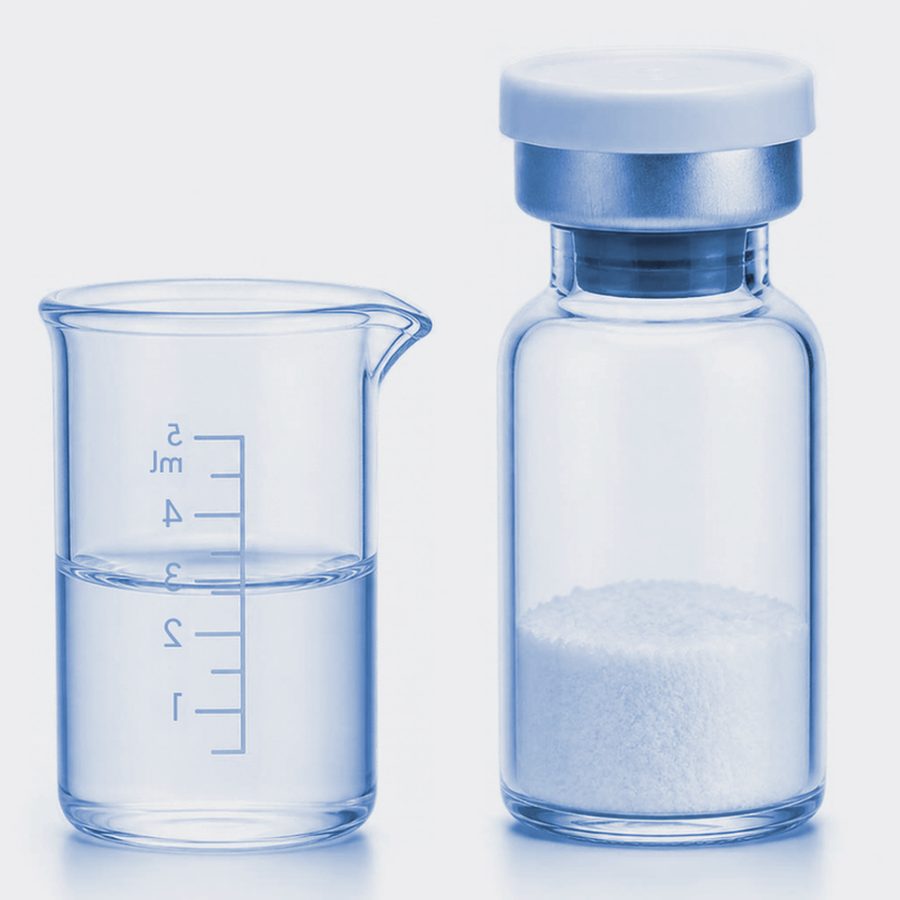
Lyophilized peptide vials are reconstituted by adding bacteriostatic water (0.9% benzyl alcohol) slowly along the inside wall of the vial. The powder should dissolve without shaking. Common bacteriostatic water volumes are 1 mL or 2 mL per vial. Real Peptides sells bacteriostatic water at $4.80 for a 10 mL vial. After reconstitution, the solution should be refrigerated and used within 28 days.
Concentration Calculation
Concentration (mcg/mL) = total peptide in vial (mcg) / volume of water added (mL). For a 5 mg (5000 mcg) vial reconstituted with 2 mL of water: 5000 / 2 = 2500 mcg/mL. Each 0.1 mL (10 units on a U-100 insulin syringe) would contain 250 mcg. For a 10 mg vial with 2 mL: 10000 / 2 = 5000 mcg/mL, and 0.1 mL = 500 mcg.
Route of Administration in Published Studies
Intraperitoneal (IP)
The vast majority of BPC-157 studies used IP injection. This route delivers the peptide directly into the peritoneal cavity, where it is absorbed through the peritoneal membrane into systemic circulation. IP injection is standard in rodent research but is not used clinically in humans. The pharmacokinetics of IP administration do not translate directly to subcutaneous or intramuscular routes.
Oral and Intragastric
BPC-157's acid stability allows oral administration in rats. For gut-specific endpoints (gastric ulcer protection, colitis models), oral BPC-157 produced results comparable to IP injection. For systemic endpoints (tendon, muscle), oral bioavailability and distribution are less well characterized. Whether oral BPC-157 reaches distant tissues at effective concentrations in any species is an open question.
Subcutaneous and Topical
Some studies tested local subcutaneous injection near the injury site or topical application as a cream. Both showed trends toward positive outcomes. These routes are more relevant to how human communities discuss use, but the published data using these routes is smaller than the IP dataset. For the BPC-157 peptide therapy landscape, see our BPC-157 peptide therapy guide.
| Route | Number of Studies | Primary Model | Clinically Used in Humans? |
|---|---|---|---|
| Intraperitoneal (IP) | 30+ | Most tissue types | No (research only) |
| Oral / intragastric | 8+ | Gastrointestinal | Yes (if formulated) |
| Subcutaneous (SC) | 5+ | Local injury | Yes |
| Topical (cream) | 3+ | Wound, muscle | Yes |
| Intravenous (IV) | 1 (human pilot) | Safety assessment | Yes (clinical setting) |
Common Mistakes in Online Dose Discussions
- Treating the HED as a proven dose. The human equivalent dose from BSA scaling is a Phase I trial starting point, not an efficacy dose. It exists for regulatory planning, not self-administration.
- Ignoring route differences. Converting a rat IP dose to a human SC dose without accounting for absorption and bioavailability differences produces a meaningless number.
- Assuming flat dose-response in humans. Some BPC-157 rat studies showed comparable effects at nanogram and microgram doses. Whether this pattern holds in humans is unknown.
- Citing the Lee/Burgess pilot as a dose protocol. That study tested safety at a specific IV dose in two people. It is not an efficacy study and was not designed to determine optimal dosing.
- Mixing peptide quantities. Vendors sell vials by total content (5 mg, 10 mg). Study doses are reported per kilogram body weight. Converting between these requires knowing the subject's weight, the reconstitution volume and the injection volume.
FAQ
What is the standard BPC-157 dose?
There is no standard human dose. The most common dose in published rat studies is 10 mcg/kg body weight administered once daily via intraperitoneal injection for 14 days. This is an animal research protocol. No clinical trial has established a therapeutic dose for humans. See our peptide calculator for reconstitution arithmetic.
Can I use allometric scaling to calculate my dose?
Allometric scaling produces an estimate used by regulatory scientists to plan Phase I trial starting doses under medical supervision. It is not a consumer dosing tool. The FDA's own guidance document warns that additional safety factors, route-of-administration adjustments and pharmacokinetic data must be incorporated before the first human dose is administered in a clinical trial.
Why did the human pilot study use such a high dose?
Lee and Burgess administered up to 20 mg IV (roughly 285 mcg/kg for a 70 kg person), which is far above the naive HED of 1.6 mcg/kg from BSA scaling. IV delivery bypasses absorption barriers, and the study was designed to assess safety at escalating doses, not to match preclinical efficacy protocols. The design choices reflect clinical pharmacology judgment, not community dosing conventions.
Does peptide dosage differ by injury type?
In the animal literature, the same dose range (10 mcg/kg IP) was used across tendon, muscle, gut and nerve models. Some gastric studies also tested 10 ng/kg with comparable outcomes. Whether dose requirements would vary by tissue target in humans is completely unknown because no human efficacy trial has been conducted for any indication.
Discuss any peptide product with a qualified physician before use. The products described on this site are sold for laboratory and research purposes and are not approved for human therapeutic use by any regulatory agency.
Compare the current picks
Prices, sizes and ratings side by side, updated when the merchant pages change.
Compare peptides